
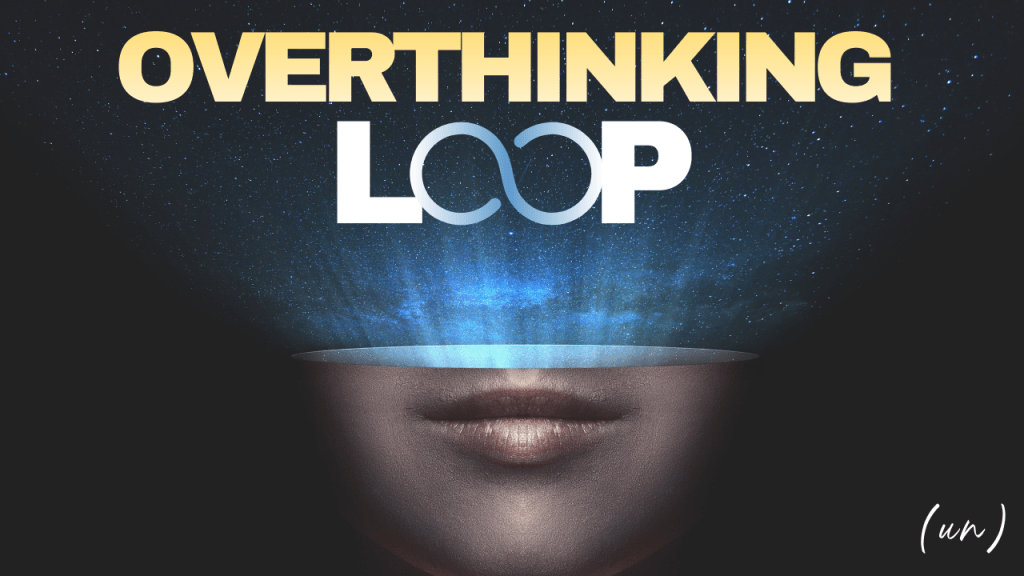
Why do simple decisions feel so heavy sometimes?
You open a menu and can’t choose.
You stare at an email and rewrite it five times.
You delay a small decision as if it could change your entire future.
This experience has a name: overthinking.
And no — it’s not a personality flaw.
It’s not a lack of intelligence.
It’s a misunderstanding of what decisions are actually for.
Most people believe that a decision must lead to the best possible outcome.
So the mind starts searching for certainty.
For guarantees.
For an option that removes all regret.
But simple decisions were never meant to carry that kind of weight.
The hidden mistake behind overthinking
Overthinking begins when you treat reversible decisions as if they were permanent.
What to eat.
What to say.
When to reply.
Which option to choose today.
Most of these choices can be adjusted, corrected, or changed later.
But your mind doesn’t label them that way.
It treats everything as final.
So instead of deciding, you loop.
You analyze.
You simulate futures that will never happen.
And time quietly passes.
A better way to think about decisions
1. Redefine what a decision is
A decision is not a commitment to an outcome.
It’s a test.
A small experiment.
A temporary direction.
When you see decisions as experiments, your mind relaxes.
There’s nothing to protect.
Nothing to get perfect.
Only something to try.
2. Limit the time you allow yourself to decide
Overthinking feeds on open-ended time.
So give your mind a container.
Thirty seconds.
One minute.
Sometimes even ten seconds.
When time runs out, you choose.
Not because the choice is perfect —
but because momentum matters more than precision for simple things.
3. Ask a better question
Instead of asking:
“What’s the best option?”
Ask:
“What’s the next small step?”
The mind handles steps better than futures.
Steps don’t demand certainty.
They only demand movement.
4. Stop trying to predict how you’ll feel later
Overthinking is often emotional prediction.
You imagine regret.
Embarrassment.
Discomfort.
And you try to avoid them in advance.
But humans are terrible at predicting future emotions.
So don’t ask your mind to solve a problem it can’t solve.
Decide based on what you know now —
not on imagined feelings later.
5. Lower the importance of the decision on purpose
Say it out loud if you need to:
“This does not deserve my full mental energy.”
Not everything is a turning point.
Most things are just moments.
And moments pass whether you overthink them or not.
The quiet truth about decisive people
People who seem decisive aren’t more confident.
They’re just less attached to being right.
They trust their ability to adjust.
To recover.
To recalibrate.
Overthinking fades when you stop trying to choose the perfect path
and start trusting your ability to walk whatever path you choose.
Decisions don’t shape your life as much
as your relationship with uncertainty does.
So choose.
Move.
Adjust later.
That’s how clarity is built.
Not by thinking more —
but by moving sooner.
Watch the full episode
This article is based on today’s episode of UNVEIL, where we explore how the mind creates unnecessary pressure around simple choices — and how to break the loop.
UNVEIL
The mind, revealed.
A deeper layer of the same pattern
Overthinking isn’t just about thinking too much.
It’s about getting stuck in loops.
In the next episode, Unveil explores a more dangerous version of the same loop — when impulse disguises itself as hope.

 Unveil Neuroscience
Leave a comment