
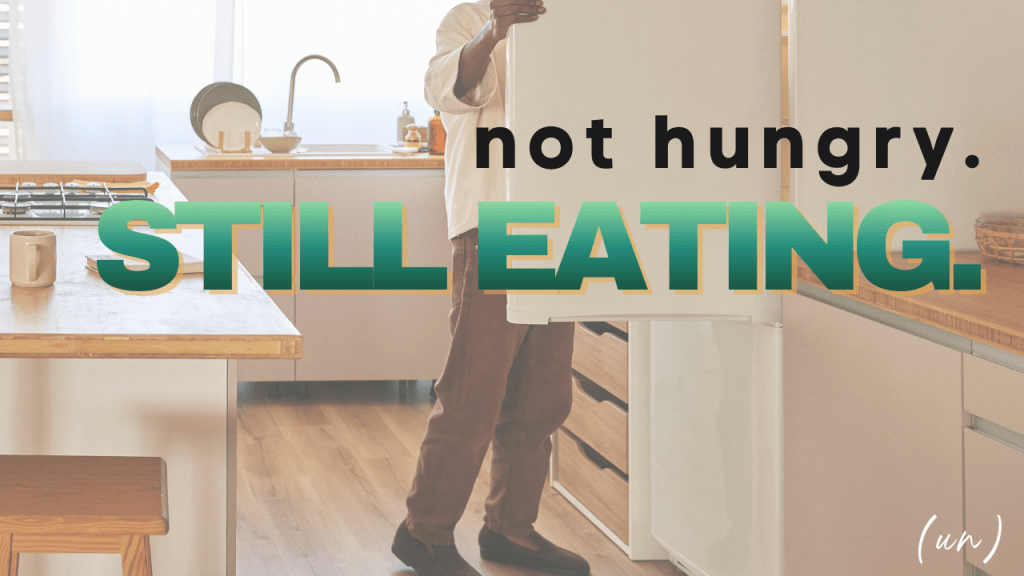
Some eating habits don’t come from hunger.
They come from something quieter — and harder to notice.
You open the fridge not because your body needs fuel,
but because something inside you is restless.
Stress.
Boredom.
Loneliness.
Mental fatigue.
Food becomes a shortcut.
Not to nourishment — but to relief.
And that’s why compulsive eating feels confusing.
You’re not craving food.
You’re craving regulation.
The real reason you eat without hunger
When your nervous system is overloaded, it looks for fast ways to settle itself.
Food works because it’s predictable.
It’s available.
And it produces an immediate sensory shift.
The brain doesn’t ask, “Is this healthy?”
It asks, “Does this change how I feel right now?”
And food almost always does.
That doesn’t make you weak.
It makes you human.
Why willpower doesn’t work here
Most advice focuses on control:
- Eat less
- Avoid temptation
- Be disciplined
- Just stop
But control is a top-down strategy.
Compulsive eating is a bottom-up problem.
When the body is dysregulated, the mind loses leverage.
This is why restriction often backfires.
The more you try to suppress the urge,
the louder it becomes.
Not because you’re failing — but because the system underneath hasn’t been addressed.
What’s actually happening in the moment
Before you eat impulsively, there’s usually a pattern:
- Internal discomfort appears
- The body seeks relief
- The mind grabs the fastest available option
- Temporary calm arrives
- The loop reinforces itself
Notice something important:
The relief comes before the food matters.
That’s the key.
How to interrupt the loop (without fighting it)
1. Delay instead of deny
Don’t say “no” immediately.
Say “not yet.”
Give yourself five minutes.
This small pause lowers urgency and shows your nervous system that the sensation is survivable.
Often, the urge softens on its own.
2. Regulate before you decide
Before reaching for food, try one regulating action:
- A slow walk
- Cold water on the face
- Deep nasal breathing
- Writing one sentence about how you feel
If the urge remains after regulation, eat — consciously.
This shifts eating from compulsion to choice.
3. Feed the need underneath
Ask a better question:
“What is this moment asking for?”
Rest?
Stimulation?
Comfort?
Connection?
Food is often a stand-in for something else.
When the real need is met, the intensity drops.
4. Remove moral judgment
Compulsive eating survives on shame.
Shame tightens the nervous system —
and a tight system seeks relief even more urgently.
Replace judgment with observation.
Not: “Why am I like this?”
But: “Interesting. This happens when I feel ___.”
Awareness loosens the loop.
5. Shrink the time horizon
You don’t need to “fix” this forever.
Just focus on this moment.
Compulsion lives in futures.
Regulation lives now.
The deeper shift
This isn’t about eating perfectly.
It’s about learning to listen earlier.
When you notice discomfort sooner,
you don’t need extreme behaviors to quiet it.
Over time, the urge loses its edge.
Not because you fought it — but because you no longer need it.
Watch the full Unveil episode
If you prefer to listen or watch, you can explore today’s episode here:
A quiet reminder
Compulsive eating isn’t a failure of discipline.
It’s a signal.
When you learn to calm the system underneath the urge,
the urge stops shouting.
Awareness comes first.
Relief follows.
You may also want to read:
Why You Overthink Simple Decisions — And How to Stop

 Unveil Neuroscience
Leave a comment