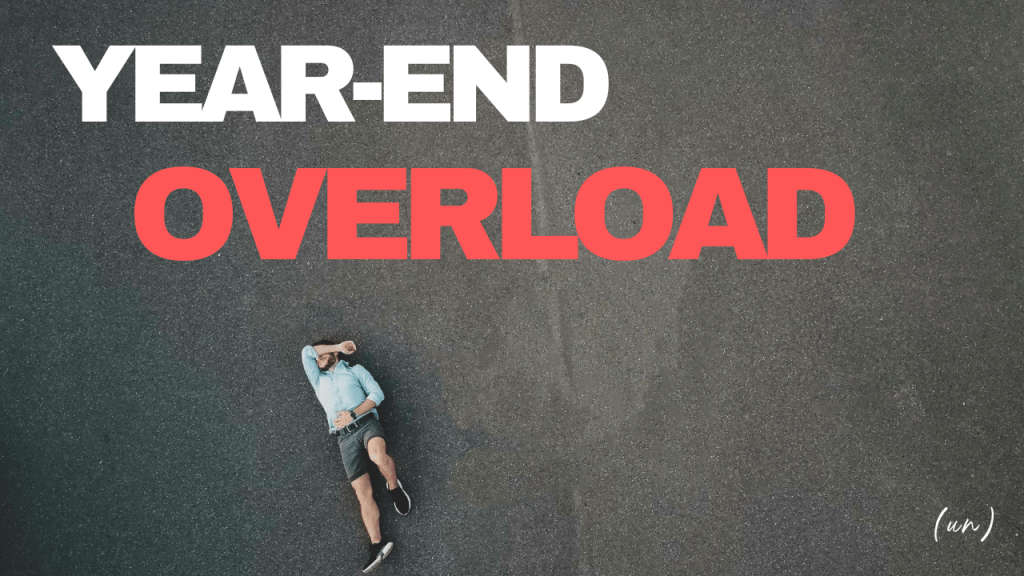
Why your brain feels overwhelmed in December — and what’s really happening beneath the surface
December doesn’t just feel heavier.
Your brain is genuinely working harder.
As the year comes to an end, many people report the same symptoms: mental fatigue, irritability, lack of focus, emotional numbness, and a strange mix of exhaustion and restlessness. Even joyful moments feel draining. Rest doesn’t seem to restore energy. And the idea of “just pushing a little more” feels unbearable.
This isn’t a personal failure.
It’s neurobiology.
Year-end exhaustion is not just about being busy — it’s about how your brain processes unfinished cycles, constant stimulation, and emotional load all at once.
Your brain is not designed for open loops
Throughout the year, your brain accumulates what neuroscientists call open cognitive loops.
Unfinished projects.
Unmet expectations.
Goals that didn’t happen.
Conversations that never closed.
Decisions postponed for “next year.”
Each one occupies a small amount of mental energy. Alone, they’re manageable. Together, they overload the system.
By December, your brain is no longer processing tasks — it’s carrying mental residue. And residue consumes attention even when you’re resting.
That’s why lying down doesn’t feel like rest anymore.
Decision fatigue peaks at the end of the year
Every decision costs glucose, attention, and executive control. By December, your prefrontal cortex — the part responsible for planning, focus, and self-regulation — is depleted.
You’re not weaker.
You’re metabolically tired.
This is why:
- small decisions feel overwhelming
- motivation drops
- patience disappears
- procrastination increases
Your brain isn’t lazy. It’s protecting itself.
Emotional overload is processed as physical fatigue
The nervous system doesn’t separate emotional stress from physical stress. To your brain, pressure is pressure.
Deadlines, family expectations, social obligations, financial evaluations, end-of-year reflections — they all activate the same stress pathways.
Cortisol stays elevated longer than it should.
The body remains in a semi-alert state.
Recovery never fully happens.
This creates a paradox:
You feel exhausted, but you can’t truly relax.
Why December feels heavier than it “should”
There’s another layer most people overlook: temporal compression.
At the end of the year, your brain subconsciously tries to make sense of time. It evaluates what happened, what didn’t, and what it means about you.
That silent question runs in the background:
“Was this year worth it?”
This internal audit consumes enormous cognitive and emotional resources — even if you’re not consciously thinking about it.
This isn’t burnout. It’s overload.
Burnout develops slowly.
Year-end exhaustion spikes suddenly.
The difference matters.
What you’re feeling is not collapse — it’s saturation.
And saturation doesn’t require force.
It requires relief.
What actually helps your brain recover
Not motivation.
Not productivity hacks.
Not pushing harder.
Your nervous system needs signals of closure and safety.
Simple but powerful interventions:
- intentionally closing small loops (even symbolic ones)
- reducing stimulation instead of adding “self-care tasks”
- slowing the pace of input — fewer screens, fewer decisions
- allowing moments of unstructured rest
Your brain doesn’t need more plans.
It needs fewer demands.
The most important reframe
You are not behind.
You are not broken.
You are not failing December.
You are experiencing the natural limit of a system that carried an entire year.
Rest is not quitting.
Slowing down is not weakness.
And exhaustion is not a flaw — it’s feedback.
A quiet invitation
If you feel overwhelmed right now, you don’t need to fix anything.
Sometimes the most regulating thing you can do is stay still for a few minutes. Let the nervous system downshift. Let the noise fade.
Below, you can watch the full video version of this reflection — and if you choose, stay a little longer with a calm piece of music designed to help your system unwind.
Because recovery doesn’t begin with effort.
It begins with permission.
This is UNVEIL.
The mind, revealed.
If this resonated with you, you may also want to explore:
What Happens When Your Brain Gets No Notifications — how silence reshapes attention and emotional regulation.

 Unveil Neuroscience
Leave a comment