Collective panic rarely begins with an event. It begins with a vague sensation that something is wrong — even when no one can clearly explain what that is.
The human brain does not need concrete evidence to enter a state of alert. Repeated ambiguity is enough for the nervous system to interpret the environment as threatening. Before a conscious thought forms, the body has already accelerated, attention has narrowed, and anxiety has quietly taken its place.
What we experience first is not fear as an emotion, but tension as a state. Muscles tighten, breathing becomes shallow, perception sharpens. Only later does the mind search for explanations to justify what the body is already feeling.
When this happens at an individual level, we call it anxiety. When it happens collectively, it feels like an atmosphere — a sense that something unsettling is unfolding everywhere at once. Biologically, however, the mechanism is the same.
The brain evolved to detect threat patterns long before it evolved to understand complex systems. That ancient circuitry never disappeared. It simply lost its braking system in a world of constant stimulation, urgency, and exposure.
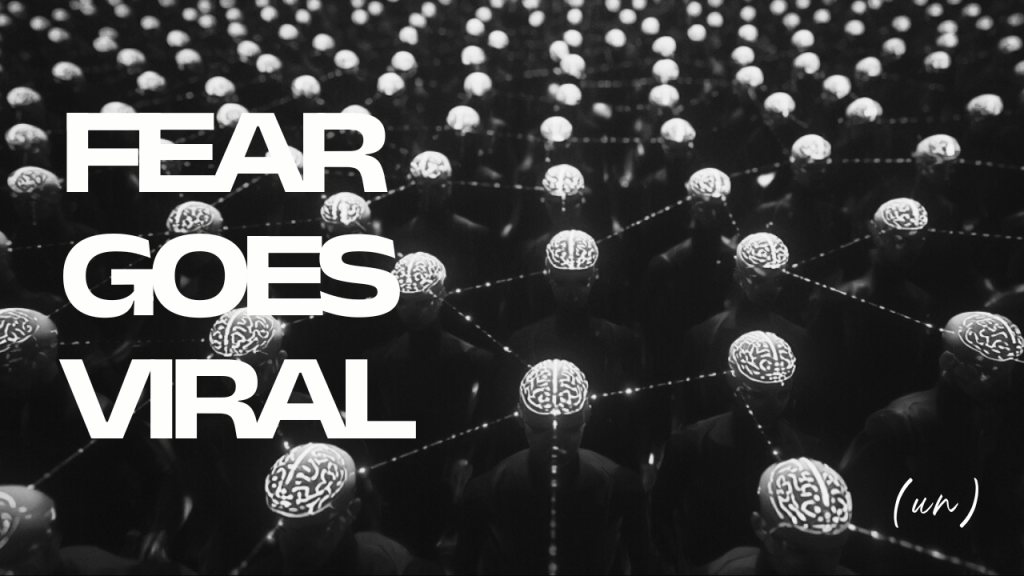
Collective panic does not spread through logic or evidence. It spreads through emotional contagion.
The nervous system is highly sensitive to social signals: tone of voice, facial expressions, sudden changes in group behavior, shifts in urgency and rhythm. When enough people appear tense at the same time, the brain interprets this as confirmation of danger — even if the threat itself remains undefined.
This reaction occurs below conscious awareness. The amygdala responds before the rational cortex can evaluate context. Once the body enters a state of alert, the mind begins searching for reasons. Headlines, images, and fragmented narratives become convenient explanations for an alarm that was already sounding.
Modern media environments amplify this process. Emotions travel faster than information, and fear moves faster than any other signal. From an evolutionary perspective, this makes sense: overreacting was always safer than missing a threat.
The problem begins when alertness stops being temporary and becomes continuous. The nervous system was never designed to remain activated for long periods. Under chronic collective panic, nuance disappears. Everything feels urgent. Everything feels extreme. Everything feels personal.
In this state, decision-making becomes impulsive, thinking turns rigid, and the sense of agency erodes. People believe they are responding to reality, when in fact they are responding to a nervous system that no longer remembers what calm feels like.
Collective panic is not mass hysteria. It is biology without recovery.
The question that remains is not whether the world is objectively more dangerous, but how much of the fear we feel comes from external conditions — and how much comes from a brain that has forgotten how to turn the alarm off.
This sense of collective tension doesn’t come from isolated events. It emerges when the nervous system begins to treat the entire environment as unsafe — a deeper layer of anxiety explored in:

 Unveil Neuroscience
Leave a comment