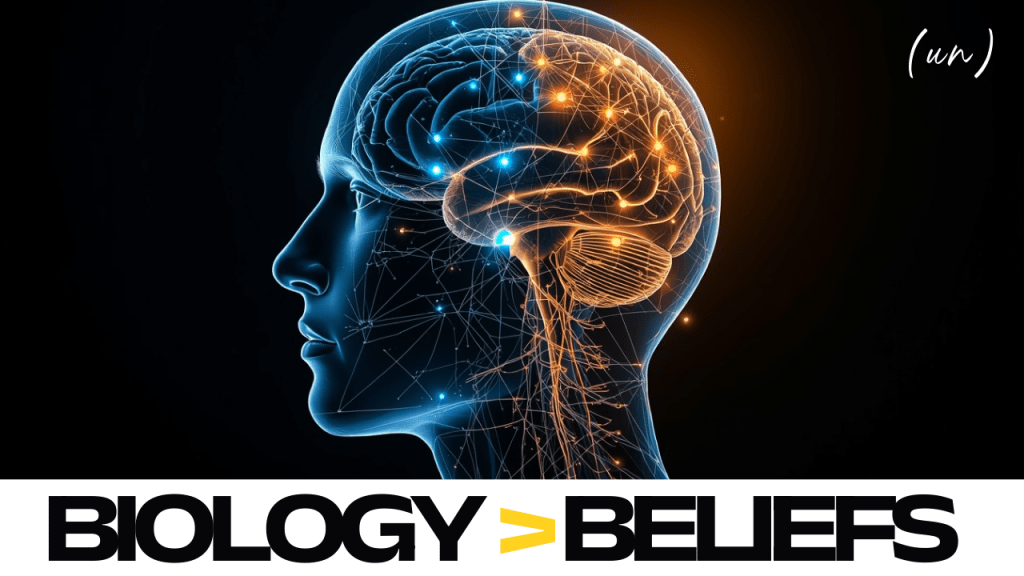
The silent consequences of ignoring biological reality
There is a comforting idea in modern culture:
that the body can be trained to follow belief.
That with enough conviction, discipline, or moral clarity, biology will adapt ; quietly, obediently — to whatever framework we choose.
But biology doesn’t work that way.
It never has.
Biology doesn’t argue. It responds.
The human body is not philosophical.
It does not debate, negotiate, or protest.
It receives signals.
It processes inputs.
And it adapts: quietly, invisibly, relentlessly.
Every cell operates on availability:
energy, nutrients, raw material.
When those inputs change, biology doesn’t ask why.
It simply reallocates.
Less of this.
More of that.
Shut systems down.
Preserve what matters most.
And the system that matters most is always the same:
The nervous system.
The brain always gets paid first
The brain consumes a disproportionate amount of the body’s energy.
It regulates emotion, impulse control, threat detection, and motivation.
When resources are abundant, the system is generous.
You feel calm. Clear. Stable. Resilient.
But when key inputs slowly disappear, the brain doesn’t panic.
It adapts.
Cognitive sharpness dulls.
Mood regulation weakens.
Anxiety becomes easier to trigger.
Fatigue arrives without explanation.
Not as a failure — but as a protective response.
Modern diets, ancient machinery
Our nervous system evolved under conditions of nutritional density, not abundance without substance.
It expects:
- complete proteins
- stable amino acid availability
- micronutrients that support neurotransmission
When those inputs drop — gradually, quietly — the system compensates.
Not with alarms.
But with behavioral shifts.
You don’t feel “deficient.”
You feel:
- unmotivated
- emotionally reactive
- mentally foggy
- strangely fragile under pressure
And because the change is slow, we rarely connect it to food.
Ideology doesn’t feed neurons
This is where confusion enters.
Modern narratives often frame nutrition as a moral or ideological choice.
But neurons don’t respond to belief systems.
They respond to chemistry.
You are free to choose any framework you want — ethical, cultural, philosophical.
But biology will still respond to the actual inputs it receives, not the story behind them.
There is no punishment.
No rebellion.
Only consequence.
Why the symptoms feel psychological
When the nervous system operates under constraint, it changes behavior first.
Not labs.
Not metrics.
Behavior.
You hesitate more.
You avoid risk.
You overthink.
You feel “off,” but can’t explain why.
This is not weakness.
It’s a system reducing exposure to threat when resources are limited.
The invoice always arrives — quietly
Biology never sends warnings in bold letters.
It sends subtle signals:
- less emotional margin
- lower stress tolerance
- delayed recovery
- increased baseline anxiety
And because these changes feel internal, we blame ourselves.
Motivation.
Discipline.
Mindset.
Rarely do we look at the raw materials the system depends on.
Reality is not political
This conversation isn’t about promoting a specific diet.
It isn’t about attacking beliefs.
It’s about understanding a simple truth:
Biological systems adapt to conditions, not convictions.
You can choose your ideology freely.
But your nervous system will still operate on availability, chemistry, and survival logic.
And it will always choose protection over preference.
The quiet advantage of alignment
When biological inputs and lived reality align, something subtle happens.
The system relaxes.
Motivation returns without force.
Emotional regulation stabilizes.
Mental clarity improves; not dramatically, but consistently.
Not because you tried harder.
But because the system no longer needs to defend itself.
Final thought
Biology doesn’t negotiate.
It doesn’t argue.
It doesn’t shame.
It adapts.
And once you understand that, the question shifts from belief to responsibility.
Not ideological responsibility; but biological stewardship.
 Unveil Neuroscience
Leave a comment