
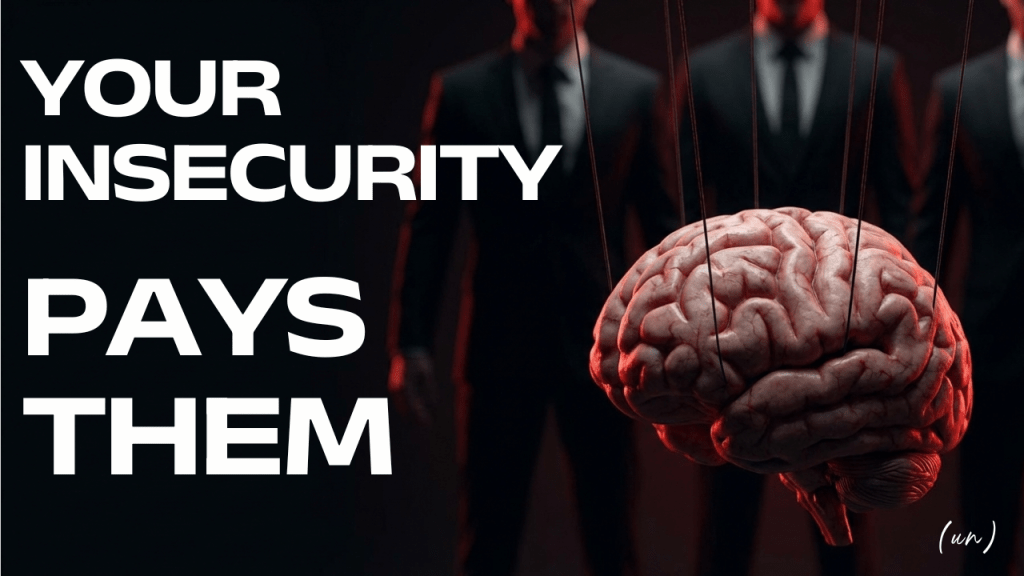
If you truly felt enough, a large part of the self-help industry would shrink overnight.
That’s not an insult.
It’s a structural observation.
Modern self-improvement does not operate purely on transformation. It operates on insufficiency. Not necessarily in malicious ways. But systematically.
The model is simple:
Identify a flaw.
Amplify the flaw.
Offer a solution.
Introduce a new flaw.
The goalpost moves.
You improve your productivity. Now your mindset is the issue.
You strengthen your mindset. Now your discipline isn’t optimized.
You build discipline. Now you discover deeper trauma.
You address trauma. Now you need higher performance habits.
Growth becomes perpetual revision.
And perpetual revision creates psychological instability.
The language of the industry reinforces this dynamic:
Level up.
Upgrade.
Unlock your next version.
Become your highest self.
The implication is subtle but powerful: you are never complete in your current form.
This framing feels empowering. It promises expansion.
But psychologically, it anchors identity in “not yet.”
If you are always becoming, you are never enough now.
That gap — between who you are and who you should be — is economically powerful.
Because insecurity drives consumption.
A person who feels fundamentally lacking seeks guidance.
A person who feels incomplete seeks instruction.
A person who doubts their internal authority seeks external frameworks.
And content consumption becomes continuous.
This does not mean self-help is inherently harmful. Growth is real. Therapy works. Reflection matters.
The issue is not improvement.
The issue is dependency.
When optimization becomes identity, improvement stops being a tool and becomes a loop.
The loop works like this:
You feel slightly behind.
You consume content to close the gap.
You feel temporarily empowered.
A new gap is introduced.
You consume again.
It feels like progress.
But often, it is managed insecurity.
Real psychological growth produces something different.
It reduces dependency on constant advice.
It strengthens internal regulation.
It increases self-trust.
A psychologically integrated person does not need constant optimization frameworks. They can act without endless input.
That kind of autonomy is stabilizing.
But autonomy does not scale as well as insecurity.
A self-trusting individual consumes less.
A regulated nervous system does not binge motivational content.
A secure identity does not obsess over becoming “better” every week.
And here lies the uncomfortable tension:
An industry built on optimization cannot thrive on widespread wholeness.
Because wholeness ends the loop.
So the question is not whether self-improvement is good or bad.
The real question is:
Are you growing…
or are you participating in a system that subtly depends on your sense of inadequacy?
If the content you consume consistently makes you feel slightly unfinished, slightly behind, slightly insufficient — that is not random.
Insecurity is economically productive.
Wholeness is not.
And the most radical shift in modern life may not be upgrading yourself again.
It may be deciding that, for now, you are enough.

 Unveil Neuroscience
Leave a comment