You wake up.
You answer emails.
You meet deadlines.
You show up.
From the outside, everything works.
And because everything works, no one asks questions.
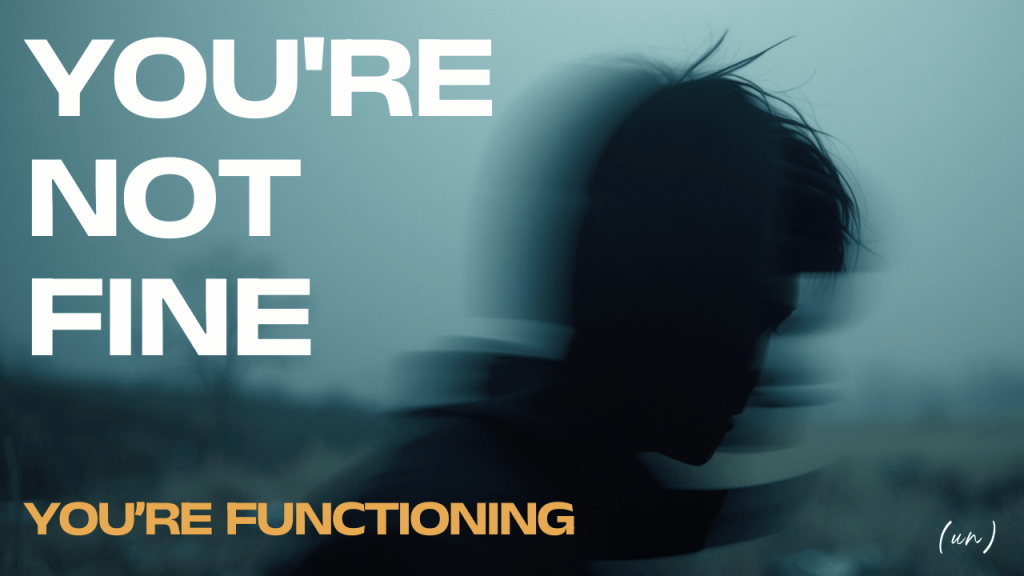
But functioning is not the same as being okay.
The Modern Illusion of “Normal”
Modern life has redefined what “fine” looks like.
If you’re productive, you’re fine.
If you’re responsive, you’re fine.
If you’re not collapsing, you’re fine.
The bar for being “okay” has been reduced to operational capacity.
Can you perform?
Can you deliver?
Can you keep up?
If yes — you must be doing well.
But performance is not well-being.
High-Functioning Distress
There is a quiet category of suffering that rarely gets named:
High-functioning distress.
You’re tired, but not enough to stop.
Anxious, but not enough to alarm anyone.
Disconnected, but still socially active.
Overwhelmed, but still reliable.
You keep going.
And because you keep going, the system assumes you’re stable.
The danger is not breakdown.
The danger is adaptation.
When the Nervous System Learns to Survive
The human nervous system is built for survival, not fulfillment.
If stress becomes constant, the body adapts.
If overload becomes normal, the brain recalibrates.
If hyper-responsibility is rewarded, you internalize it.
You don’t collapse.
You normalize the pressure.
Over time, anxiety stops feeling like anxiety.
It starts feeling like personality.
Exhaustion stops feeling like a warning.
It starts feeling like adulthood.
Functioning as Camouflage
Modern culture rewards output, not regulation.
You can be dysregulated and productive.
You can be disconnected and efficient.
You can be chronically stressed and successful.
Functioning becomes camouflage.
And camouflage is dangerous, because it hides the signal.
If you’re still moving, no one sees the cost.
Sometimes not even you.
The Hidden Cost
The hidden cost is subtle.
It’s the constant background tension.
The inability to rest without guilt.
The feeling that stopping equals falling behind.
The sense that you’re holding everything together — and if you loosen your grip, everything collapses.
But here’s the truth:
Being capable is not the same as being safe.
Being responsible is not the same as being regulated.
Being admired is not the same as being supported.
A Better Question
Instead of asking:
“Am I functioning?”
Ask:
“Does my body feel safe?”
“Can I slow down without panic?”
“Do I exist outside of what I produce?”
If the answer is no, you may be surviving exceptionally well.
But survival is not the same as living.
Final Thought
The modern world doesn’t always break you.
Sometimes it trains you to endure what you shouldn’t.
And endurance, when misinterpreted as strength, becomes invisible erosion.
You can be high-performing and still overwhelmed.
You can be admired and still exhausted.
You can be functioning — and not okay.
The two are not the same.


Leave a comment